![[personal profile]](https://www.dreamwidth.org/img/silk/identity/user.png)
Beginning the Year With Dance
Jan. 6th, 2023 03:33 pmThrowdown Collective is an award-winning contemporary dance company based out of Toronto. They have been doing a dance residency in Waterloo region, and invited several local dancers to participate. Although I've essentially been retired from dancing for a few years, I was grateful to receive an invitation. The workshop was sponsored by MT Space, an organization which is amazingly supportive of the arts, locally, nationally, and internationally. They're kind of a big deal.
Day 1 was held in the Charles Room of Kitchener's Downtown Community Centre. It's a tiny dance studio with an amazing sprung hardwood floor--probably the best floor I've ever danced on in Waterloo region. I used to teach in that studio several years ago, and it was nice to be back. After we all did our Covid rapid tests, we took our masks off and many of us jumped off the deep end of our comfort zones. Although I have often worked in tight proximity with other people over the years (eg. acro yoga, martial arts, contact dance), I have not been in close contact with other people since the beginning of the pandemic. Our first dance exercise was based off of slow-motion hugging/embracing. We paired up with another dancer and worked through this exercise, which after three years of physical distancing, felt scary, transgressive, intimate, and tender. Being close enough to feel skin on skin, smell shampoo, hear breath while moving up and down from the floor took me back to experiments with butoh and contact dance. And when we broke the group into two sections so we could watch the other dancers work together, it was fascinating to see the unplanned synchronicities of movement.
The second half of the day was spent working on walking at the same tempo while moving in separate patterns from the other dancers. The synchronization gradually dissipated, and then dancers would collapse, and other dancers would help them up, press them back down to the floor, or ignore them. It was a simple exercise, but it yielded complex dynamics, and was fun to watch, too! Dramas unfolded, and some comedy, too.
Unfortunately for me, I developed a limp, and by the time I got home, my foot was very sore. It appears that something has been lodged beneath the skin close to my toes for some time (maybe a sliver or a piece of gravel), and when I went into relevé, all my bodyweight pressed onto that spot so it felt like I'd jumped onto a four-sided die. There's a nasty bruise there, and I was afraid I wouldn't be able to participate in the second day of the workshop. I woke up feeling down, but rather than call and cancel, I decided to pivot. I brought a sketchbook with me because at the very least, I could sketch the workshop.
Day 2 began with takeout from Three Kretans (I had the lemon chicken soup: it's good) at the Registry Theatre. I've danced at this theatre many times over the past seventeen years, but never on a rotating stage!
I've still not danced on a rotating stage. I kept my winter boots on so I wouldn't accidentally go into relevé again and re-injure my foot, so I stayed off the stage in order to not get it dirty. The first half of the day was spent in groups of three on the spinning stage. Each dancer did a figure eight with a consistent walking tempo, with each dancer coming in on the fifth step. The result was sort of dance fugue, something like a movement-based rendition of singing in rounds. Paired with the spinning stage, dancers frequently got lost in their figure-8s. When rotating is put into the mix, it seriously messes with proprioception. Eventually, the dancers got it figured out, and it looked a bit like a human spirograph or the Scrambler ride at the fair done on foot.
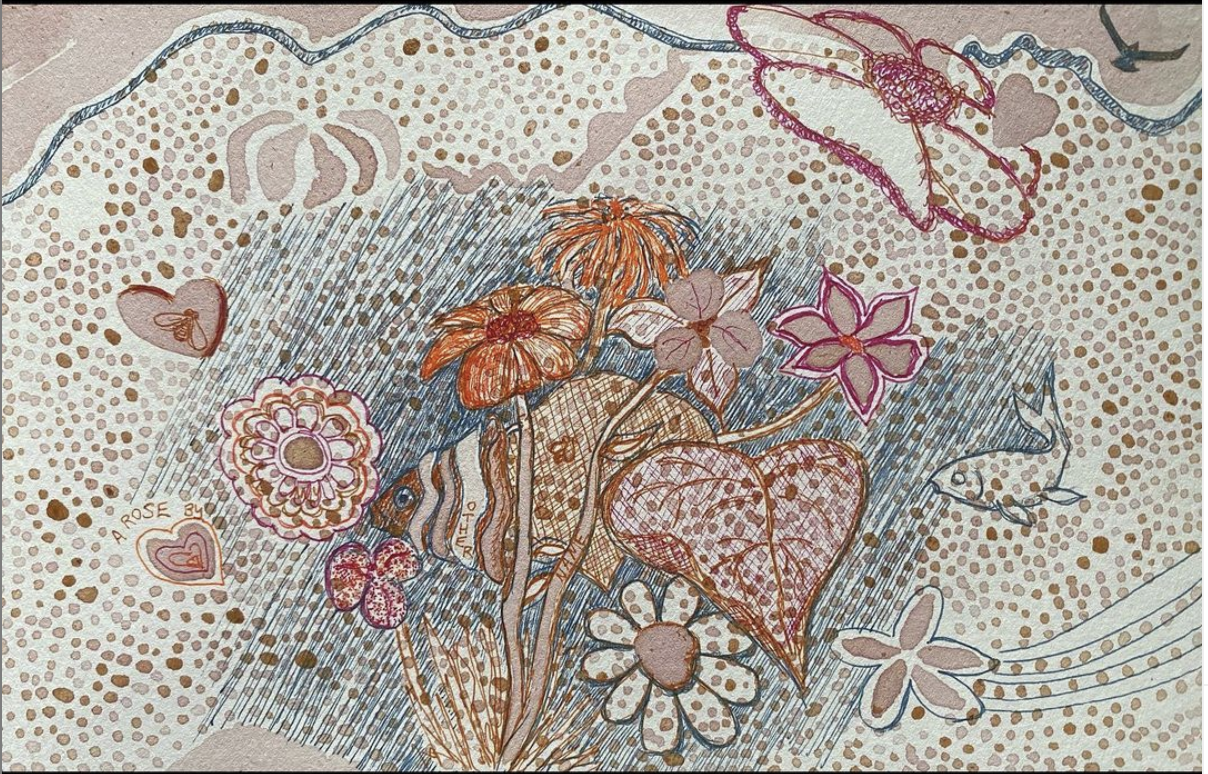
Since I was unable to safely participate in this part, I decided to do a drawing of the sounds I heard. These single-line drawings demarcate the rhythms I heard, the various instruments of the music, and the footfalls of the dancers.

The second half of day two was something I did feel safe participating in. I am not good at memorizing choreography. That being said, this choreography was simple enough that even I didn't have a hard time learning it. I stood off to the side of the stage to do a cycle of swaying, side stepping, and finger snapping on 8 counts. Each cycle got bigger and bigger until the rhythms began to disintegrate and movements grew wild. It was a lot of fun, and my hair, which has grown very long again over the pandemic, started dancing with me.
I've missed dancing with big hair.
I'm grateful I got to participate in this residency. Hopefully, the next time around, my body will not malfunction and I will be able to throw myself into dancing again with full exuberance.
Day 1 was held in the Charles Room of Kitchener's Downtown Community Centre. It's a tiny dance studio with an amazing sprung hardwood floor--probably the best floor I've ever danced on in Waterloo region. I used to teach in that studio several years ago, and it was nice to be back. After we all did our Covid rapid tests, we took our masks off and many of us jumped off the deep end of our comfort zones. Although I have often worked in tight proximity with other people over the years (eg. acro yoga, martial arts, contact dance), I have not been in close contact with other people since the beginning of the pandemic. Our first dance exercise was based off of slow-motion hugging/embracing. We paired up with another dancer and worked through this exercise, which after three years of physical distancing, felt scary, transgressive, intimate, and tender. Being close enough to feel skin on skin, smell shampoo, hear breath while moving up and down from the floor took me back to experiments with butoh and contact dance. And when we broke the group into two sections so we could watch the other dancers work together, it was fascinating to see the unplanned synchronicities of movement.
The second half of the day was spent working on walking at the same tempo while moving in separate patterns from the other dancers. The synchronization gradually dissipated, and then dancers would collapse, and other dancers would help them up, press them back down to the floor, or ignore them. It was a simple exercise, but it yielded complex dynamics, and was fun to watch, too! Dramas unfolded, and some comedy, too.
Unfortunately for me, I developed a limp, and by the time I got home, my foot was very sore. It appears that something has been lodged beneath the skin close to my toes for some time (maybe a sliver or a piece of gravel), and when I went into relevé, all my bodyweight pressed onto that spot so it felt like I'd jumped onto a four-sided die. There's a nasty bruise there, and I was afraid I wouldn't be able to participate in the second day of the workshop. I woke up feeling down, but rather than call and cancel, I decided to pivot. I brought a sketchbook with me because at the very least, I could sketch the workshop.
Day 2 began with takeout from Three Kretans (I had the lemon chicken soup: it's good) at the Registry Theatre. I've danced at this theatre many times over the past seventeen years, but never on a rotating stage!
I've still not danced on a rotating stage. I kept my winter boots on so I wouldn't accidentally go into relevé again and re-injure my foot, so I stayed off the stage in order to not get it dirty. The first half of the day was spent in groups of three on the spinning stage. Each dancer did a figure eight with a consistent walking tempo, with each dancer coming in on the fifth step. The result was sort of dance fugue, something like a movement-based rendition of singing in rounds. Paired with the spinning stage, dancers frequently got lost in their figure-8s. When rotating is put into the mix, it seriously messes with proprioception. Eventually, the dancers got it figured out, and it looked a bit like a human spirograph or the Scrambler ride at the fair done on foot.
Since I was unable to safely participate in this part, I decided to do a drawing of the sounds I heard. These single-line drawings demarcate the rhythms I heard, the various instruments of the music, and the footfalls of the dancers.
The second half of day two was something I did feel safe participating in. I am not good at memorizing choreography. That being said, this choreography was simple enough that even I didn't have a hard time learning it. I stood off to the side of the stage to do a cycle of swaying, side stepping, and finger snapping on 8 counts. Each cycle got bigger and bigger until the rhythms began to disintegrate and movements grew wild. It was a lot of fun, and my hair, which has grown very long again over the pandemic, started dancing with me.
I've missed dancing with big hair.
I'm grateful I got to participate in this residency. Hopefully, the next time around, my body will not malfunction and I will be able to throw myself into dancing again with full exuberance.